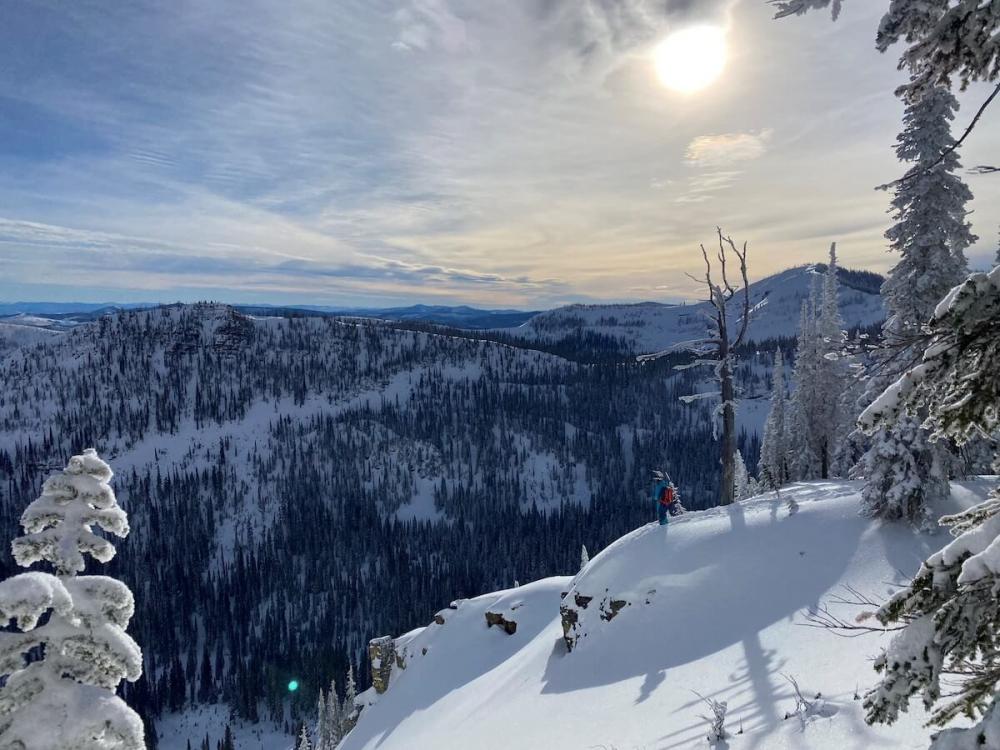
We recently had a chance to sit down with Kyle Huestis, one of our agents based out of the Seeley Lake office, to discuss his passion for snowmobiling as he prepares for a busy season in the backcountry. Kyle is a successful agent with Clearwater and always manages to make time to get out for a powder adventure. Here’s what Kyle had to say about how he prefers to spend the winter months.
CP: We love that despite how busy you are, you are able to get out and do what you love most and that you even share this passion with your clients! How did you get into snowmobiling?
KH: I got into snowmobiling at a very young age with my family. I rode with my parents until I was old enough to handle my own sled at the age of 4, and haven’t missed a season yet. It was easy for me to stay in the sport growing up as a farmer. There was ample downtime in the winter to focus on snowmobiling, and I had a shop to work on them to boot. Snowmobiling is a special way to see the mountains in ways that most can’t imagine. It allows a person to cover mountain ranges faster than any other way. You can’t ski, hike, bike, or drive the mountains like you can on a snowmobile. The soft white blanket of snow covers obstacles and allows riders to adventure the snowy landscape like never before in record speed. The complete freedom to go any direction your ability will allow, you can go on your machine. My fascination with mountain top views and seeing what’s on the other side is just as strong as it was when I was young. That’s why I do it! Today I share this passion by offering an all-inclusive snowmobile experience in beautiful Seeley Lake, Montana - lodging, backcountry guiding, riding clinics, and snowmobile rentals. Whether you have never been on a snowmobile, or if you are a seasoned veteran looking to push your riding abilities, we have you covered at Freshies Built.
CP: What is the best way to prepare for a backcountry adventure?
KH: Start with your gear! Definitely a helmet - a good full-face helmet is best. This gives protection to the rider and warmth on colder days. Next, a good set of winter boots - something with thick soles, very waterproof, and preferably with ankle support. Gloves are key, and not just one pair! I pack 4 sets with me. No glove stays dry when you’re riding. They either get wet from digging, sweating, or from snow coming over the bars. I pack a warm trail set to ride in, as it’s cold in the morning; then cycle through two thin pairs during the day and a nice extra-warm pair when it’s time to go to the truck. Next is a good set of winter pants, and a jacket. I prefer a one-piece snowsuit, which leaves fewer areas for snow to get in, and areas to let body heat out. I’d also recommend a backpack for food, survival equipment, including multiple ways to start a fire, a first aid kit, a flashlight, a probe, and a shovel.
Safety equipment that is a must for every rider, is an avalanche transceiver, commonly called a beacon, a shovel, and a probe. The beacon is used to locate other beacons in order to recover a person buried in the snow. Having a beacon is one thing, but knowing how to use and operate one, in an emergency, is another. Riders should know how to use their equipment and practice before going out, even if it’s in the parking lot prior to the ride. A good way to practice is to have a designated person in the group (which should change for each ride for learning purposes) put their beacon into search mode and check each member of the group prior to going on trail. This ensures all beacons are working properly - in both search and transmission modes. Batteries are a huge factor to consider. I recommend changing them out if they are below 90% battery life, as they will drain fast once pulled out in the cold. Beacons should be worn secured to your chest using the manufacturer-provided harness. The shovel and probe should also be worn on your person, usually inside your backpack.
CP: What is the best way to navigate through the terrain, especially if you are new to the area?
KH: Trail maps are provided for almost any riding area. These will show the maintained and unmaintained trails in the area. However, for the popular freeriding technique, there are rarely any trails nearby. I use the onX maps app for most of my GPS, if I need it. It allows me to keep track of my pace throughout the day. It also helps me decide the best way to navigate new terrain by using the topographic layers for elevation changes.
For someone starting out, stick to the trails until you feel comfortable going off trail. Always remember landmarks and things you ride by to help you to get out. And absolutely use GPS at least to track yourself so if all fails you can go back the way you came. Never go down something you don’t think you can get back up the same way. If you get separated from the group, stay in the last place you were with your group. They should know to go back to the last place they saw you as well.
CP: I know it is relatively easy to get stuck. If that happens, what should you do?
KH: If you get stuck, the most important thing is to use the least amount of energy to get unstuck. It’s not uncommon to get stuck 10 times or more in a day when backcountry riding. Maneuvering a 500-lbs+ machine in waist-deep snow can seriously wear a person out, and thus cause more stuck situations. The key is to take your time, focus on staying dry, dig out the snow around the front of the machine under the skis and belly to allow the nose to drop, lifting the stuck rear track out of the snow. Another great technique when applicable is to control-roll the sled to the downhill side and back on its track.
CP: How about the sled - what is a better machine and why?
KH: There are four major manufacturers now: Arctic Cat, Polaris, Skidoo, and Yamaha. Within those makers, they have essentially two styles of sled: your mountain sled which will have longer (≥146”), deeper tracks, and will be built for off-trail type riding. And, trail sled, with shorter (≤146’’) lugs and more plush suspension for long trail rides. Each works great for their application and as far as what manufacturer you go with, I always say, “it doesn’t matter what you ride, just as long as you ride!”
CP: What is the most dangerous situation you have ever been in?
KH: The most dangerous situation I have been involved in snowmobiling, is an accident with a tree. I hit a tree going downhill, and was launched into another tree face first, breaking many bones in my face. I had to hike for 30 minutes before my group found me. The takeaway would be to always make sure someone in your group knows where you are, and vice versa. The buddy system is key in this sport.
CP: What are some of the risks?
KH: Some of the risks associated with snowmobiling would be frostbite and hypothermia. These can be avoided with proper gear including being prepared for spending a night out in the woods. Keeping dry and switching out wet gear like gloves or neck warmers can greatly decrease your chances of frostbite. Some other major risks include avalanches and injuries that can occur while riding a power sports vehicle. Avalanches can be avoided by reading the reports to know conditions, avoiding runouts and terrain traps. If you are not interested in taking that risk, trail riding would be the best and, in most cases, safe and out of the way of avalanche danger.
CP: How do you read the snow to ensure safety?
KH: Before each day of riding, a rider should check the local avalanche center. Nearly all areas are covered or closely covered by a daily snow report provided by these centers. These reports specify the conditions of where and how avalanches are likely to occur. Some days this may mean you are good to go for the whole area, while other days it means you may have to switch your planned route. They can also mean that some days it is best to stay home - because conditions are too dangerous. After reading the reports, you’ll have a better understanding of what is going on out in the mountains. However, conditions can still vary, even in the same area, and caution should be used exercised in all terrain that is within your path of travel. Cornices and chute runouts should be avoided if possible. Check with each member of the group to make sure they have the proper safety equipment and that they are educated on how to use each piece of equipment should there be an emergency.
CP: What do you consider to be the most epic ride you’ve ever been on?
KH: I can’t name a specific ride but ideally, you wake up in the morning, open the door to your lodge to find fresh snow on your truck, drive to the trailhead and find a foot of fresh snow in the parking lot. The sun starts to burn through the early morning clouds, and the sky clears. When you get up high, you discover the landscape has been completely covered in waist-deep, light, fluffy goodness to start your adventure. These are the days most sledders dream of.
CP: Sounds amazing! Where are some of your favorite places to go?
KH: Some of my favorite places to ride would include areas surrounding West Yellowstone, Island Park, Idaho, Lolo Pass, and the Bridger Range - when we’re excluding Seeley Lake, of course. These areas offer a variety of conditions with different terrain, elevations, and snow patterns. That’s what drew me to live in Seeley Lake - the amazing riding and pristine snowfall. The Mission and Swan Mountain Ranges, near Seeley Lake, are home to some of the world’s finest winter recreation. The combination of low elevation, warmer temps, and high-water content create a unique snowpack much as you would find in areas like Revelstoke, British Columbia. These factors give the snow a firm yet forgiving consistency that allows both snowmobilers and skiers to play as they see fit on features with little risk of hitting items hidden below the surface.
The most popular trailhead for snowmobilers in this area is the Fawn Creek trailhead, located just 7 miles north of Seeley Lake, on the Northwest end of the lake. This trailhead gives access to areas like Elsina Lake and Marshall Lake, where true backcountry riding begins! Running all the way north to the Mission Mountain wilderness area, providing riders with a truly unique experience that all levels of riders can enjoy! The terrain gives way to vast rock shelves, steep chutes, and open tree riding. With a 30-year average of over 100” base of snow, there is no shortage of pow. Definitely one of the best areas in the state.
Kyle Huestis has been with Clearwater Properties for 3 years and has an excellent reputation within his community, volunteering in local organizations such as the Seeley Swan Search and Rescue. When he is not helping guide his clients to their real estate goals, he is guiding his clients through the wild and beautiful Montana backcountry during the winter. He owns and operates a premier, all-inclusive snowmobile company in Seeley Lake, MT. Freshies Built offers a snowmobile experience that is second to none with lodging, backcountry guide services, technical riding clinics, and snowmobile rentals. Let this Montana local show you around.