Discover Southern Montana: A Hidden Gem
Explore Bozeman, Red Lodge, Billings, and Beyond – Where Adventure, Culture, and Nature Collide
A lot of people think of Glacier National Park, Flathead Lake or Big Sky when they think of Montana, but locals and adventure seekers know that Southern Montana expanding east to Billings and beyond is where miles upon miles of untouched beauty can be found. From peaks to plains, Southern Montana is peppered with small-town charm, incredible history, and infinite open horizons. These areas are where infamous figures like Butch Cassidy, the Sundance Kid, and Calamity Jane called home. Long before that, many Native American people of various tribes such as Crow and Northern Cheyenne flourished throughout the area. History buffs to culture junkies will love exploring all that this vast land offers. Bozeman is a vibrant place with all the things you want from a college town: great restaurants, nightlife, incredible live music, and thriving arts and culture, all surrounded by countless recreational possibilities.
Bozeman was founded in 1864 by John Bozeman, a frontiersman from Georgia who led wagon trains west to the gold fields in the Montana Territory along the Bozeman Trail, a branch of the Oregon Trail. The town served as a supply hub for prospectors looking to strike it rich. Today, year-round festivals, concerts, museums, and shopping elevate “the West’s best mountain town”. The nearby Bridger Range, to the north, and the Spanish Peaks, to the south, have amazing trails for skiing, biking, and hiking.
Before the arrival of permanent settlers, the Red Lodge countryside and surrounding valley was Crow country, serving as a place to worship, rest and hunt for their people. Rocky Fork Coal Company opened the area’s first mine in 1887, and hundreds of immigrants from around the world arrived looking for work. Just a few years later, the Sundance Kid and crew famously robbed the local bank… or did they? Others claim that the “Wild Bunch” got cold feet and split. After the suspects left town, Sheriff John Dunn, with a posse in tow, took up the pursuit. The bandits were captured near Lavina, but the Sundance Kid evaded arrest. Later the Great Depression shut down the coal mines and bootlegging became the town’s main export, and a couple of decades later, tourism and ranching replaced coal and bootlegging. Now, Red Lodge is an agricultural town full of appeal.
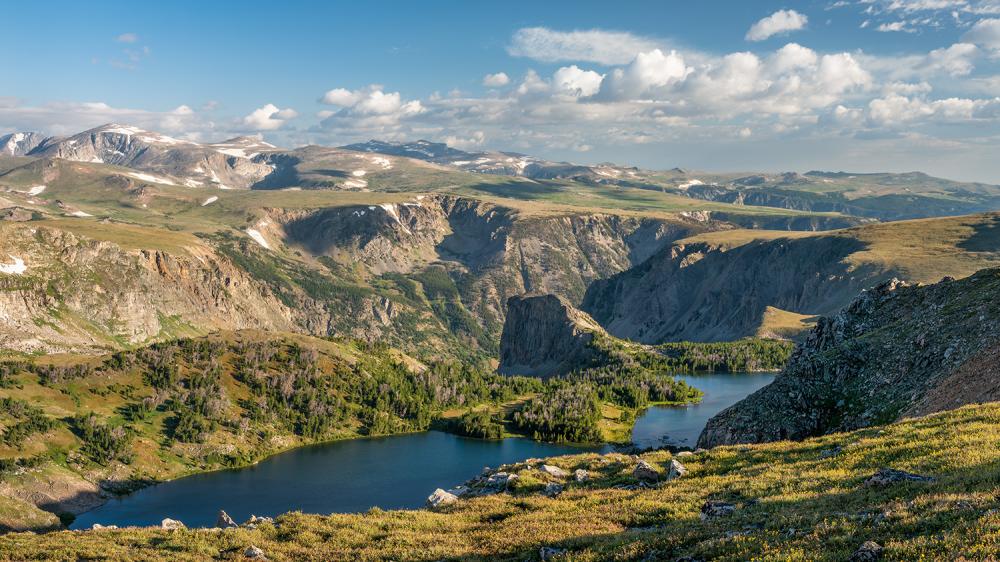
Red Lodge’s neighboring Custer-Gallatin National Forest comprises over three million acres and includes both the Absaroka-Beartooth and Lee Metcalf Wilderness within its boundaries. The Beartooth Mountains are home to the highest 41 peaks in Montana including Granite Peak, which at 12,807 ft is the highest point in Montana. It serves as the northeastern gateway to Yellowstone National Park. Tucked away in the rugged mountains, over 700 glaciers can still be found in the Beartooths. Elk, deer, grizzly bear, black bear, mountain goats, bighorn sheep, mountain lions, and many other animals call the Beartooth Mountains home. The Beartooth Highway, which opened in 1936, is commonly known as one of the world’s most beautiful and dramatic roads.
Billings, otherwise known as “The Magic City of Montana”, was established in 1882 and named after Fredrick H. Billings, president of the Northern Pacific Railway. The city was formed by the railroad as its railhead for further westward expansion. It was aptly nicknamed “The Magic City” due to its rapid growth as 2,000 buildings were built within the first few months of being settled. To go back before this time, visit the Pictograph State Park to learn more about prehistoric hunters that called Montana their home over 2,000 years ago. These hunters left behind thousands of artifacts and over 100 pictographs as well. Artifacts that were excavated from the site include stone tools, weapons, paintings, and various other instruments used. The pictographs’ interpretations are still subject to debate, but the images of animals, warriors, and even rifles tell a story that has lasted thousands of years. The Billings International airport is a convenient gateway to Big Sky Country and beyond. Billings is a central point to some of the best southern Montana attractions, and the city is alive with street festivals, outdoor concerts, sporting events, and recreation.
East of Billings, hidden in a vast open landscape of rolling hills and the biggest sky, lie some treasures that would stun even the most seasoned and well-traveled hikers and horseback riders around the state. One of those treasures is the Ashland Ranger District. The expanse, much like others we’ve already mentioned, provides endless opportunities for outdoor recreation, including hiking, riding, camping, hunting, cross-country skiing, and snowshoeing. Included in this block of federal land are three designated hiking and riding areas – the Tongue River Breaks, Cook Mountain, and King Mountain, all of which are closed to motorized vehicles and make up more than 40,000 acres of pristine wild country.
The Warrior Trail Highway will take you on a scenic drive through Custer National Forest and the Northern Cheyenne Indian Reservation before ending at the Little Bighorn Battlefield, just outside of Crow Agency, Montana. This is the shortest route from Mount Rushmore to the Little Bighorn Battlefield. This is where Custer’s Last Stand took place, the infamous battle where the Sioux, Cheyenne, and Arapaho tribes went head-to-head with the 7th Calvary Regiment of the United States Army. Warriors, Sitting Bull and Crazy Horse, lead these tribes to victory over the U.S. forces, resulting in the most significant action of Native Americans fighting for their land. If you’ve never visited the battle site, it is easily worth the stop. Park rangers and indigenous guides give tours of the battlefield where white gravestones mark the spots where hundreds of soldiers fell.
The expanse between Custer-Gallatin National Forest and the Tongue River Breaks creates a sparsely populated mecca of recreation, wildlife, and splendor. The towns throughout this region hold important pieces of our nation’s history. American writer John Steinbeck once called this area a “love affair.” It’s easy to see why. Southeastern Montana’s diverse landscape of badlands, flatlands, mountains, and rolling hills is one of few places where the Wild West lives on.
Ready to explore the hidden gems of Southern Montana? Contact Clearwater Properties today to find your perfect outdoor escape!